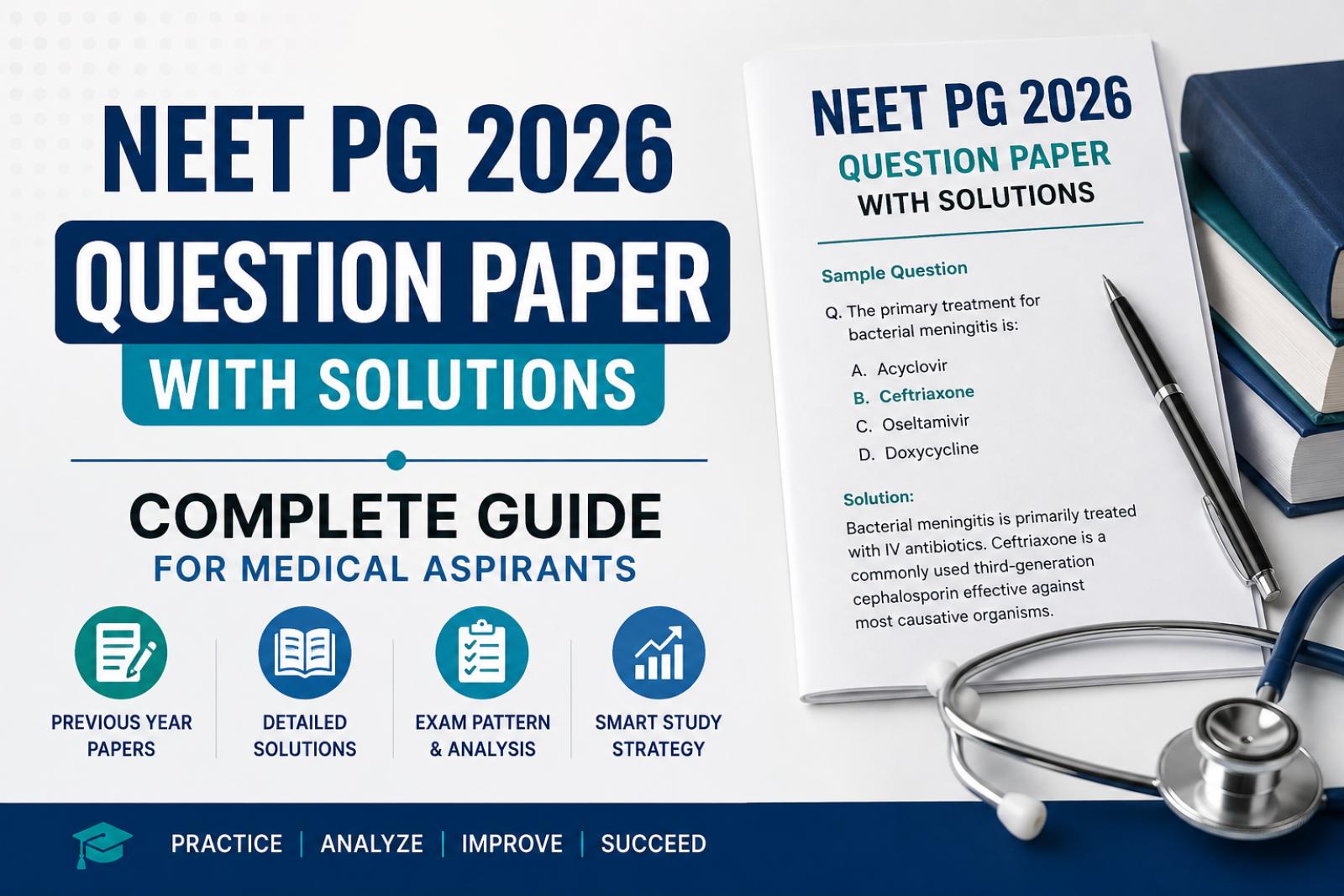
Every year, lakhs of medical graduates across India sit for the National Eligibility cum Entrance Test for Postgraduate courses, commonly known as NEET PG. For the 2026 session, the exam was scheduled on August 30, 2026, and candidates are now looking for the NEET PG 2026 question paper with solutions to review what was asked, estimate their score, and strengthen weak subjects before results and counselling begin.
Here is the important detail most students miss: the National Board of Examinations in Medical Sciences (NBEMS) does not routinely publish the full official NEET PG question paper after the exam. What you find online within hours or days of the test are memory-based recall questions—reconstructed from what candidates remember about clinical vignettes, image descriptions, answer options, and the concepts tested. These recalls are extremely useful for revision and pattern analysis, but they are not identical to the actual exam paper word for word.
This guide explains how NEET PG 2026 recall papers are prepared, what the exam pattern looked like, how to use solutions effectively, and how the broader medical education journey—from school-level science foundation to undergraduate NEET and finally postgraduate specialisation—connects with coaching hubs like Sikar in Rajasthan.
What Is the NEET PG 2026 Memory-Based Question Paper?
A memory-based NEET PG question paper is a community-driven reconstruction of the exam. After candidates finish their test, they share what they remember: the clinical scenario, laboratory values, imaging findings, the four options, and sometimes the answer they marked. Education platforms and coaching institutes then compile these inputs, organise them subject-wise, and attach expert-verified solutions.
Because recall depends on human memory, you may notice:
Slight differences in question wording compared to the actual screen text
Missing image details or incomplete lab value tables
Variations in how different students describe the same question
Occasional disagreement on the correct option until expert faculty review the concept
Despite these limitations, recall papers remain one of the most practical post-exam resources. They reveal which topics dominated the paper, whether questions leaned clinical or basic science, and which integrated concepts—such as pharmacology applied to a medicine case—appeared repeatedly.
Official Paper vs Recall Paper: Know the Difference
Understanding this distinction protects you from overconfidence or unnecessary panic when estimating your score.
| Aspect | Official NEET PG Paper | Memory-Based Recall Paper |
|---|---|---|
| Released by NBEMS | Not routinely published in full | Compiled by students, educators, and media platforms |
| Question wording | Exact computer-based text | Approximate reconstruction |
| Images and figures | Original radiology/pathology slides | Often described in words by candidates |
| Answer key status | Official key not publicly released for all items | Expert solutions based on standard textbooks |
| Use for score prediction | Only official result is final | Provides a rough estimate, not a certified score |
NEET PG 2026 Exam Pattern and Marking Scheme
Before analysing any question paper, confirm the structure under which NEET PG 2026 was conducted. The pattern has remained focused on multiple-choice clinical and basic science questions delivered in a computer-based format with sectional timing.
| Particular | Details |
|---|---|
| Exam name | NEET PG 2026 |
| Exam date | August 30, 2026 |
| Total questions | 180 MCQs |
| Total marks | 720 |
| Question type | Multiple choice (single best answer) |
| Sections | 5 timed sections |
| Questions per section | 36 |
| Time per section | 42 minutes |
| Correct answer | +4 marks |
| Incorrect answer | −1 mark (negative marking) |
| Unattempted | 0 marks |
The sectional design matters when you review recall questions. Each block of 36 questions had its own clock, meaning time management within sections was as critical as overall accuracy. When you practise with memory-based papers, try simulating this structure rather than attempting all 180 questions in one uninterrupted sitting.
Why Sectional Timing Changes Your Revision Strategy
Unlike many undergraduate exams where you can revisit flagged questions freely across the entire paper, NEET PG’s section-bound timing rewards decisive reading and quick clinical reasoning. During post-exam analysis, note not only whether you knew the concept but whether the question type—long clinical stem versus short one-liner—influenced your speed.
When Will the NEET PG 2026 Question Paper Be Available?
Memory-based NEET PG 2026 questions typically begin circulating within hours after the exam concludes, as candidates discuss recalls in social media groups, hostel rooms, and coaching centre debrief sessions. More structured, subject-wise compilations with verified solutions usually appear within one to three days, depending on how consistently students report questions across exam shifts and cities.
Reliable compilations generally sort recalls into standard MBBS subjects and clinical disciplines, including:
Medicine and allied specialties
General surgery and surgical subspecialties
Obstetrics and gynaecology
Paediatrics
Pathology and microbiology
Pharmacology
Community medicine (PSM)
Anatomy, physiology, and biochemistry
Ophthalmology, ENT, orthopaedics, radiology, anaesthesia, dermatology, psychiatry, and forensic medicine
If you appeared for NEET PG 2026, contribute your remembered questions to trusted platforms only after the exam—sharing live exam content during the test violates examination rules and can have serious consequences.
Subject-Wise Analysis: What NEET PG 2026 Recalls Typically Reveal
While the exact question list varies by shift, NEET PG papers consistently blend clinical application with basic science foundations. Based on trends from recent NEET PG exams and early 2026 recall patterns reported by candidates, the following themes are commonly tested.
General Medicine and Critical Care
Medicine usually carries significant weight. Expect case-based questions on sepsis management, electrolyte disturbances, acid-base disorders, diabetes complications, infectious diseases, and ECG interpretation. Vasopressor selection in refractory septic shock, criteria for ICU admission, and interpretation of arterial blood gas reports are recurring concept areas.
General Surgery and Emergency Scenarios
Surgery recalls frequently test acute abdomen evaluation, trauma protocols, hernia classifications, thyroid and breast surgery complications, and imaging findings such as free gas under the diaphragm suggesting hollow viscus perforation. The ability to identify the next best step—rather than the definitive long-term treatment—is often the key to selecting the correct option.
Obstetrics and Gynaecology
OBG questions commonly distinguish between placental abruption, placenta previa, uterine rupture, and vasa previa using bleeding pattern, uterine tone, fetal status, and gestational age clues. Antenatal screening, contraception, PCOS, and gynaecological oncology markers also appear regularly.
Pathology, Microbiology, and Pharmacology
Basic science subjects are rarely isolated. A pathology recall may embed Hodgkin lymphoma subtypes with immunohistochemistry markers; microbiology may present CSF findings in bacterial meningitis; pharmacology may test adverse drug reactions such as neuroleptic malignant syndrome or serotonergic toxicity. Integrated revision across these three subjects pays disproportionate dividends.
PSM, Paediatrics, and Short Clinical Subjects
Community medicine questions often focus on screening test properties—sensitivity, specificity, predictive values—and public health programme knowledge. Paediatrics favours immunisation schedules, congenital disorders, and neonatal emergencies. Ophthalmology, ENT, and orthopaedics tend to have fewer questions individually but are high-yield because the concepts repeat across years.
Sample Question Formats You Should Practise (Illustrative Examples)
The examples below are representative practice illustrations showing the style and difficulty of NEET PG questions. They are not claimed to be verbatim recalls from NEET PG 2026.
Example 1: Medicine — Septic Shock Management
Question: A 62-year-old woman with pneumonia develops fever, tachycardia, and hypotension (BP 78/48 mmHg) despite 30 mL/kg fluid resuscitation. Lactate remains elevated. Which is the most appropriate first-line vasopressor?
Options: A) Dobutamine B) Noradrenaline C) Adrenaline D) Dopamine
Answer: B) Noradrenaline
Concept: Current sepsis guidelines recommend noradrenaline as the first-line vasopressor when hypotension persists after adequate fluid loading.
Example 2: Surgery — Acute Abdomen
Question: A patient presents with sudden epigastric pain, board-like rigidity, and erect chest X-ray showing free subdiaphragmatic air. What is the most appropriate immediate management?
Answer: Emergency surgical evaluation for suspected perforated peptic ulcer with peritonitis.
Example 3: OBG — Third-Trimester Bleeding
Question: Painless bright red bleeding at 36 weeks with a soft, non-tender uterus and reassuring fetal heart rate—most likely diagnosis?
Answer: Placenta previa (digital vaginal examination should be avoided until ruled out).
Example 4: Pathology — Hodgkin Lymphoma
Question: Reed–Sternberg cells with CD15 and CD30 positivity in a lymphocyte-rich background suggest which subtype?
Answer: Lymphocyte-rich classical Hodgkin lymphoma.
Example 5: Pharmacology — Drug Toxicity
Question: Rigidity, hyperthermia, altered mental status, and elevated CK after antipsychotic use—most appropriate management agent among dopaminergic options?
Answer: Bromocriptine (along with stopping the offending drug and supportive care) for neuroleptic malignant syndrome.
When reviewing the actual NEET PG 2026 recall compilations, treat each entry the same way: identify the concept, confirm the answer from Harrison, Bailey & Love, Robbins, Goodman & Gilman, or your standard reference, and note the clinical reasoning chain.
How to Use the NEET PG 2026 Question Paper with Solutions Effectively
Simply reading solved questions passively gives a false sense of preparation. A structured approach converts recall papers into a powerful revision engine for both 2026 candidates awaiting results and future NEET PG aspirants still in internship or final MBBS.
Attempt first, answer later: Cover the solution and try solving from the stem alone.
Tag the concept, not just the fact: Write whether the question tested diagnosis, next investigation, treatment, or complication.
Cross-check uncertain recalls: If wording feels incomplete, verify the concept in a textbook rather than debating phrasing.
Maintain an error log: Record subject, topic, reason for mistake (concept gap, careless reading, time pressure).
Reattempt after 7–10 days: Spaced repetition on previously missed recalls cements retention.
Simulate sectional timing: Attempt 36 questions in 42 minutes to rebuild exam rhythm.
Can You Calculate Your NEET PG 2026 Score from Recall Papers?
You can estimate a probable score range, but not an official result. Missing questions, incorrect recalls, and changed options all introduce error. Use this formula for rough calculation:
Estimated score = (4 × number of confirmed correct) − (1 × number of confirmed incorrect)
Mark only those questions where you clearly remember what you selected and the recalled answer key matches expert verification. Wait for the official scorecard at natboard.edu.in for confirmed results.
From School Science to NEET PG: Why Foundation Years Matter
NEET PG may feel distant when a student is still in Class 11 or 12, but the postgraduate entrance is the culmination of a long pipeline. Strong PCB fundamentals, disciplined study habits, and exposure to competitive exam culture during school years shape how comfortably a graduate handles the immense NEET PG syllabus later.
Sikar in Rajasthan has emerged as a nationally recognised hub for NEET (UG) preparation—building the undergraduate entry path that eventually leads to an MBBS degree and, for many, NEET PG specialisation. Students researching medical careers early can benefit from understanding this ecosystem. Read our detailed report on why Sikar is becoming India’s fastest-growing NEET coaching destination in 2026 for context on infrastructure, faculty quality, and student migration trends.
Parents evaluating school options should prioritise institutions with strong science faculty, regular testing culture, and counselling support. Our guides on best schools in Sikar 2026 and best CBSE schools in Sikar 2026 compare boards, fees, and academic outcomes to help families plan early.
Choosing NEET Coaching in Sikar for the Undergraduate Stage
While NEET PG coaching is typically pursued during internship at national-level PG prep platforms, Sikar’s core strength lies in rigorous NEET UG preparation—the gateway to medical college. If you are a school-leaving aspirant or parent, explore how to choose the best NEET coaching in Sikar, our list of best NEET coaching institutes in Sikar, and the broader top coaching centres in Sikar 2026 guide before enrolling.
What Happens After NEET PG 2026: Results, Cutoffs, and Counselling
Question paper analysis is only the first post-exam step. The broader admission cycle determines where you will pursue MD, MS, or diploma courses.
Result and Scorecard
NEET PG results are published on the NBEMS/NBE official portal. The scorecard shows your total score, All India Rank (AIR), and qualifying status against category-wise cutoffs.
Qualifying Cutoffs
Cutoffs vary by category and are expressed as percentile scores. General category candidates typically face the highest threshold, while reserved categories have lower qualifying percentiles as per government rules. Previous-year cutoff trends help set realistic expectations but should not be treated as guarantees.
Counselling Pathways
Counselling proceeds through multiple channels:
MCC counselling: For 50% All India Quota seats, central institutions, and deemed universities
State counselling: For state quota seats in government and private medical colleges
Special categories: Including AFMS and other designated reservation streams
Rajasthan candidates often target institutions such as SMS Medical College Jaipur and RUHS-affiliated medical colleges during state counselling. Monitoring official MCC and Rajasthan medical education portals for registration dates, choice filling, and seat allotment rounds is essential.
Common Mistakes to Avoid When Using Recall Questions
Treating recalls as official proof: Never challenge exam authorities based solely on social media recall posts.
Ignoring negative marking in estimates: Overcounting guessed questions inflates predicted scores.
Skipping basic sciences: Many clinical questions require pathology or pharmacology linkage.
Passive reading without notes: Active recall and self-quizzing outperform highlight-only revision.
Comparing shift difficulty prematurely: Normalisation processes account for variation across sessions.
Tips for Future NEET PG Aspirants (2027 and Beyond)
If you are in MBBS now and will attempt NEET PG in a future cycle, start integrating these habits early:
Build subject-wise notes during clinical postings, not just before the exam year.
Solve previous-year and memory-based papers under timed sectional conditions.
Use standard textbooks as primary sources; coaching modules as supplements.
Join a test series that mirrors the 180-question, five-section CBT format.
Track weak areas weekly and assign focused revision blocks.
Undergraduate NEET preparation in structured environments—such as those covered in our top 10 schools in Sikar 2026 and schools in Sikar 2026 admission guides—helps students enter MBBS with the discipline needed for later PG success.
Conclusion
The NEET PG 2026 question paper with solutions—compiled from candidate recall and expert review—is one of the most valuable post-exam tools available to medical graduates today, even though it is not an official NBEMS publication. Used correctly, it helps you analyse tested concepts, estimate performance, and plan counselling strategy while awaiting formal results.
Remember the essentials: NEET PG 2026 featured 180 MCQs in five sections of 36 questions each, with +4/−1 marking and 42 minutes per section. Approach every recall question as a concept revision opportunity, verify answers against trusted medical references, and avoid treating informal score estimates as final outcomes.
For students earlier in the medical journey—still choosing schools or NEET UG coaching in Rajasthan—Sikar Study Point offers updated rankings, fee comparisons, and admission guidance across RBSE schools, English medium schools, and competitive coaching institutes. The path from school laboratory to NEET PG counselling is long, but each stage of preparation compounds—and the right guidance at the right time makes the difference.