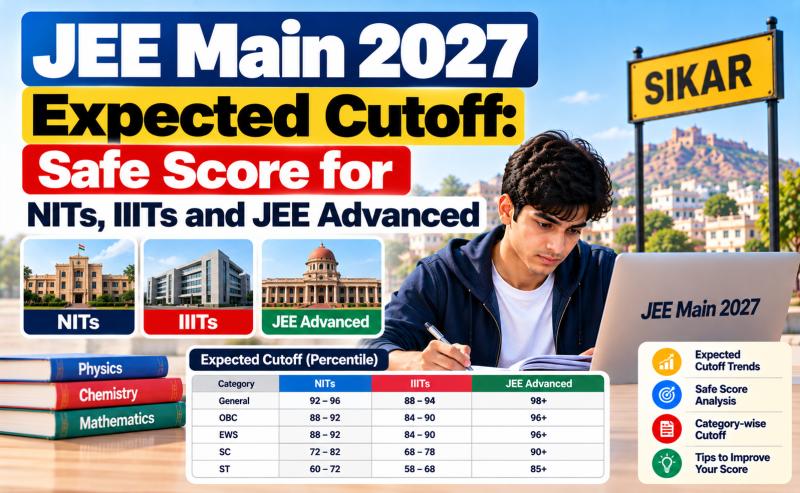
Every year, lakhs of students sit for JEE Main with the same quiet ambition: to see their name at the top of the All India Rank list. For JEE Main 2027, that dream is still within reach—but only for students who treat preparation like a long-term project, not a last-minute sprint. Rank one is not luck; it is the outcome of clear targets, NCERT-first learning, honest mock-test analysis, and daily discipline.
If you are studying in Sikar or planning to shift here for engineering coaching, you are already in one of India's most active hubs for IIT-JEE preparation. Institutes such as PCP Sikar (Prince Career Pioneer) and peers profiled in guides like JEE Coaching in Sikar 2027 compete on faculty, test series, and results—but your rank still depends on what you do after class ends. This guide explains what AIR 1 means, how NTA ranks candidates, subject-wise plans for Physics, Chemistry, and Mathematics, and practical habits Sikar aspirants can use from Class 11 through both sessions of JEE Main 2027.
Nationally, well over 15 lakh candidates register for JEE Main across both sessions in a typical year. That scale makes competition intense, yet ranks are built from small daily wins: one more NCERT revision cycle, one cleaner mock analysis, one evening spent fixing Organic instead of scrolling. Families weighing NEET 2027 coaching choices in Sikar for a sibling should still remember JEE needs dedicated Mathematics depth—plan time, hostel, and budget for each goal separately rather than assuming one institute fits every exam.
What Does AIR 1 in JEE Main 2027 Mean?
AIR 1 (All India Rank 1) is the highest position in the JEE Main merit list for a given year and session combination, as declared by the National Testing Agency (NTA). Your rank reflects your normalized score across shifts and sessions when multiple papers are held. A top rank opens doors to premier NITs, IIITs, and GFTIs through JoSAA counselling, and it strengthens your profile if you also aim for JEE Advanced and IIT seats.
Aspirants often confuse percentile with rank. A 99.9+ percentile is outstanding, but AIR 1 requires you to be among the very highest scorers nationally—often meaning near-perfect accuracy on a paper you finish with time to spare. Students currently scoring roughly 80–130 out of 300 in practice tests should not panic; they still have runway if they fix fundamentals and testing habits early in 2026–27.
JEE Main 2027 at a Glance
| Aspect | What aspirants should know |
|---|---|
| Conducting body | National Testing Agency (NTA) |
| Subjects | Physics, Chemistry, Mathematics (PCM) |
| Typical pattern | MCQs and numerical value questions; check latest NTA brochure |
| Sessions | Usually two sessions per year; best of two scores may apply for ranking |
| Foundation books | NCERT Class 11 & 12 for all three subjects |
| Registration | Watch jeemain.nta.nic.in for JEE Main 2027 dates and forms |
Why a Top Rank Is Realistic—If You Change How You Study
JEE Main is difficult, but it is also structured. The syllabus is fixed, previous papers repeat ideas, and toppers win on execution: revision cycles, error logs, and exam-day strategy. Students in cocaching clusters like Sikar benefit from daily tests and peer pressure, yet many still lose marks by skipping NCERT, hoarding books, or attempting mocks without analysis.
Before choosing an institute, compare options using independent round-ups such as PCP Sikar vs CLC Sikar, Top 7 JEE Coaching Institutes in Sikar 2027, and Best JEE Coaching in Sikar for JEE Main and Advanced. Coaching gives direction; rank-one preparation gives you repetition and feedback loops.
Complete Roadmap for JEE Main 2027 Rank-One Preparation
Use this sequence as your default plan from now until exam day:
Download the official JEE Main 2027 syllabus and mark high-weightage units.
Finish NCERT for PCM line by line—examples, exercises, and intext questions.
Set a weekly hour target (quality over vanity metrics) and protect sleep.
Build one consolidated formula and reaction sheet per subject.
Join a structured test series—many Sikar centers include this; see Top 5 JEE Coaching Centers in Sikar With High Selection Rate.
After every mock, log mistakes by concept, not just question number.
Revise NCERT multiple times before chasing advanced problem books.
Solve at least ten years of JEE Main previous year questions (PYQs).
Simulate exam conditions: CBT timer, no phone, full length.
Peak for Session 1 or Session 2 based on your school and board schedule.
Class 11 vs Class 12: When to Start Aiming for a Top Rank
Students who treat Class 11 as a free year often spend Class 12 recovering backlogs while boards and JEE sessions collide. Rank-one trajectories usually begin in Class 11 with NCERT completed subject-wise, not chapter hoarding without revision. Use Class 11 to build Mechanics, basic Organic, and Algebra comfort; use Class 12 to integrate Electrostatics, Calculus-heavy Mathematics, and Inorganic revision loops.
If you are a dropper, reset with a diagnostic mock before joining a new batch. Your edge is time—fewer school commitments—but only if you avoid repeating passive habits from the first attempt.
Month-by-Month Focus (Sample for 2026–27)
April–June: Syllabus audit, NCERT pass one for weak Class 11 chapters, join or continue coaching.
July–September: Complete major Class 12 units; weekly mocks begin.
October–December: Full-syllabus revision one; PYQ blocks by subject.
January–February: Session 1 peak if you sit early; intensify analysis.
March–April: Board exams—keep light daily formula revision.
May onward: Session 2 or Advanced bridge; reduce new content, increase tests.
Subject-Wise Strategy for JEE Main 2027
Physics: Concepts First, Numbers Second
Physics rewards understanding over memorization. For each chapter—Mechanics, Electrostatics, Current Electricity, Magnetism, Optics, Modern Physics—master the idea, then drill standard JEE-level numericals. Start with NCERT; revisit it until you can explain definitions without looking. Then use one trusted problem book (for example H.C. Verma for concept depth) rather than five half-finished sources.
Make micro-notes for derivations and common traps (sign conventions, units, graph interpretations). In mocks, note whether errors are conceptual or calculation; each type needs a different fix. Sikar classrooms often move fast; if you miss a lecture, recover the same day from notes or backup modules so backlogs do not compound.
Chemistry: Three Lanes—Physical, Organic, Inorganic
Treat Chemistry as three mini-subjects. Physical Chemistry needs formula clarity and repeated numerical practice (mole concept, equilibrium, thermodynamics, electrochemistry). Inorganic Chemistry is largely NCERT-driven: periodic trends, coordination compounds, and p-block facts reward spaced revision. Organic Chemistry needs mechanism thinking—learn named reactions from NCERT examples and your coaching sheets, not random internet lists.
Avoid buying every new book in the market. Stick to NCERT, institute material, and one reference where your teachers agree you need extra problems. For students who also explore medical pathways in the same city, the revision mindset parallels NEET preparation in Sikar—but JEE Main demands stronger Mathematics, so guard your math hours fiercely.
Mathematics: Daily Problem Quota and Speed
Mathematics improves only with daily touch. Fix a minimum number of problems per topic (for example 15–25 per day from calculus or coordinate geometry) and increase difficulty gradually. NCERT examples are underrated for Main-level clarity; then move to PYQs and section-wise banks.
Track average time per question type. Rank-one aspirants rarely get stuck for five minutes on a single MCQ in the actual exam—they mark, move, and return. Practice that rhythm in every timed set you attempt.
High-Weightage Chapters Worth Extra Hours
No chapter is truly skippable, but JEE Main rewards certain units repeatedly. Prioritize these while still finishing the full syllabus:
| Subject | Chapters to prioritize |
|---|---|
| Physics | Mechanics, Current Electricity, Magnetism, Modern Physics, Ray Optics |
| Chemistry | Mole concept, Chemical Bonding, Coordination Compounds, Thermodynamics, Organic conversions |
| Mathematics | Calculus, Coordinate Geometry, Vectors, 3D, Quadratic equations, Probability |
After two passes through these, rotate lower-frequency chapters so you do not lose easy marks on fringe topics.
Daily Study Schedule That Top Rank Aspirants Can Adapt
No single timetable fits every student, but high performers share a pattern: deep work blocks, short breaks, one test or analysis slot, and fixed sleep. Below is a sample you can shift earlier or later based on hostel or day-scholar life in Sikar.
| Time | Activity |
|---|---|
| 6:00 – 6:30 AM | Wake up, light stretch, plan the day |
| 6:30 – 8:30 AM | Mathematics: new concept + practice set |
| 8:30 – 9:00 AM | Breakfast |
| 9:00 – 11:00 AM | Physics: theory + numericals |
| 11:00 – 11:30 AM | Break |
| 11:30 AM – 1:30 PM | Chemistry: one of Physical / Organic / Inorganic |
| 1:30 – 2:30 PM | Lunch and rest |
| 2:30 – 4:00 PM | PYQs or institute sheets |
| 4:00 – 4:30 PM | Break |
| 4:30 – 6:30 PM | Weak topics and backlog clearance |
| 6:30 – 7:30 PM | Exercise or walk |
| 7:30 – 9:00 PM | Full or part mock test |
| 9:00 – 9:30 PM | Dinner |
| 9:30 – 10:30 PM | Test analysis and error notebook |
| 10:30 – 11:00 PM | Formula and short-note revision |
| 11:00 PM | Sleep (aim 7–8 hours) |
Study hours matter less than focused hours. Eight hours of phone-free study beats twelve distracted ones. If you live in a hostel, align mess times and room rules with this plan and communicate boundaries to friends early.
Mock Tests, PYQs, and the Analysis Habit
Mock tests are your dress rehearsal. Aim for dozens of full-length papers before the real exam—many successful candidates cross 60–70 simulated tests when counting institute exams and personal practice. Each test should end with a written analysis: wrong questions grouped by chapter, silly mistakes versus knowledge gaps, and a 48-hour revision plan for the worst two topics.
PYQs teach language and difficulty. Notice how NTA repeats themes: definite integration tricks, chemical bonding exceptions, ray diagrams, and quadratic inequalities. When your mock scores plateau, return to NCERT and PYQs instead of hunting exotic problems.
Exam-Day Paper Attempt Order
There is no universal best order, but a calm approach works for many toppers:
Start with your strongest section to build confidence (often Chemistry or Mathematics).
Attempt questions you can solve quickly on first pass.
Mark uncertain ones and return with remaining time.
Cap time per question (about 1–1.5 minutes on average in MCQ sections).
Review marked questions in the last ten minutes instead of rushing new attempts.
Building Accuracy: The Hidden Rank Separator
Two students with similar knowledge can differ by dozens of marks on Main day because of accuracy. Train accuracy by solving easy questions under a strict timer, maintaining a silly-mistake list, reading medium questions twice before calculating, and reviewing marked items in the final minutes. When institute rankings circulate, use them privately for motivation—not public score debates.
How to Push Toward 99+ Percentile and Rank-One Territory
Percentile and rank move together at the extreme top only when your score is nearly flawless. To climb from good to exceptional:
Handwritten notes: compress chapters onto revision pages you can scan in thirty minutes.
NCERT on tips: especially Chemistry inorganic lines and Physics boxed statements.
Error log: one notebook; never repeat the same mistake thrice.
Consistency: same wake time, same weekly mock day, same analysis ritual.
Health: protein-rich meals, hydration, and movement—burnout breaks streaks.
Students attached to Prince Eduhub's school ecosystem sometimes combine board stability with coaching—campuses like Prince Academy Sikar, Prince School Sikar, and Prince Lotus Valley Sikar are options families evaluate alongside pure coaching institutes. Whatever campus you choose, align board exam dates with JEE sessions so revision peaks do not collide.
JEE Main Rank One and the JEE Advanced Connection
A stellar JEE Main score does not automatically mean IIT admission—you still need JEE Advanced for IITs. Many top Main rankers also prepare for Advanced with deeper multi-concept problems. If your goal is a top IIT, treat Main as a speed-and-accuracy exam and Advanced as a thinking exam. Sikar institutes often run parallel Main and Advanced tracks; confirm batch placement and test difficulty before enrolling.
Registration, Sessions, and Score Normalization
NTA usually conducts JEE Main in multiple shifts. Normalization adjusts for varying paper difficulty across shifts. You cannot control normalization, but you can control performance within your shift: arrive early, verify system login, and read instructions calmly. Register on time when JEE Main 2027 forms open; late fees and missed city choices add stress you do not need.
If two sessions are offered, plan whether you will appear once or twice. A second session can be a safety net if Session 1 goes poorly—but only if you use the gap for targeted revision, not a complete break from practice.
Role of Parents and Teachers in a Rank-One Journey
Parents in Sikar and across Rajasthan often relocate for coaching. Healthy support means stable fees planning, hostel safety checks, and emotional steadiness—not daily score interrogations. Teachers should help interpret mock trends; students should own the error notebook. Open conversations about stress, sleep, and screen time prevent burnout.
Online Resources vs Classroom Coaching
Hybrid learning is common: classroom lectures plus online doubt apps. The danger is passive video watching without problem solving. If you supplement with online tests, mirror exam rules—timed, closed notes. For a balanced view of delivery modes in competitive prep, some families read pieces like online vs offline coaching; the lesson transfers—pick the format you will follow daily.
Mistakes That Cost Sikar Aspirants Their Target Rank
Studying without a written weekly plan.
Passive scrolling during breaks that become hours.
Skipping institute tests or sleeping through doubt sessions.
Collecting books but not finishing one NCERT cycle.
Ignoring Mathematics practice because Physics feels harder emotionally.
Mock tests without analysis—only chasing a number.
Late-night cramming that steals sleep before a real exam.
Comparing scores publicly instead of fixing private weak spots.
Choosing Coaching in Sikar for JEE Main 2027
Sikar works for JEE because of density: experienced faculty, hostel culture, and competitive batchmates. When you visit institutes, ask about batch size, test frequency, answer-key transparency, and how droppers are handled. Read comparison pieces and visit demo classes before paying long fees.
Institutes under the Prince Career Pioneer umbrella remain part of many families' shortlists; your due diligence should still include fee structure, scholarship tests, and past Main results. Use local selection guides as starting points, not the final word—verify with current students and official result lists where possible.
Health, Sleep, and Exam-Week Routine
Rank-one preparation is a marathon. Seven to eight hours of sleep stabilizes memory consolidation—especially for Chemistry facts and Mathematics procedures. Eat regular meals; dehydration wastes exam hours. Light exercise improves focus during long Sikar summer afternoons. In the final week, reduce new topics, sleep on time, pack admit card and ID, know your center route, and attempt light revision—not brutal mocks that shake confidence.
Conclusion
AIR 1 in JEE Main 2027 is not a mystery reserved for geniuses. It is the sum of NCERT mastery, thousands of deliberate problems, honest mock analysis, and calm exam execution—supported, for many Rajasthan students, by structured coaching in Sikar. Start now: tighten your syllabus map, book your next mock, and analyze yesterday's errors before tonight. Rank one begins the day you stop preparing to complete the course and start preparing to never repeat a mistake.