If you are studying in Sikar and counting days to JEE Main Session 1 in January 2027, you are not alone. Hostels on Piprali Road and coaching hubs across the city are full of the same question: syllabus incomplete, mocks uneven—what should I revise now and what can I safely leave? The honest answer from years of classroom feedback at institutes like PCP Sikar is that the last 90 days are for smart selection, not for trying to open every chapter in three fat books.
This article is written for Sikar Study Point readers—Class 12 students, droppers, and parents—who want a practical January-attempt plan aligned with NTA’s JEE Main 2027 bulletin. It is inspired by expert revision frameworks used in Rajasthan’s coaching belt but rewritten in plain language for local students. Before you block study hours, confirm your JEE Main 2027 registration is complete and error-free; mistakes at the form stage waste precious revision weeks, as our guide on common registration mistakes explains.
Which exam are you targeting in January?
JEE Main Session 1 is a computer-based test for B.E./B.Tech (Paper 1). You get three hours, 75 questions, and 300 marks—100 marks each for Physics, Chemistry, and Mathematics. Section A has 20 multiple-choice questions per subject; Section B has five numerical value questions per subject. Marking is +4 for correct, −1 for wrong, and zero for unattempted in both sections.
According to the public schedule tied to the 2027 information bulletin, Session 1 is held across multiple days in late January 2027, with Session 2 following in April. NTA uses the better of your two session totals for the merit list, so January is a real attempt—not a “trial paper.” Droppers and students who have done one full syllabus pass usually gain the most from a focused January push; others can still learn exactly which chapters cost marks before April.
| Particular | What Sikar students should note |
|---|---|
| Paper pattern | 75 questions, 300 marks, CBT, 3 hours |
| Subjects | Physics, Chemistry, Mathematics—each 100 marks |
| Session 1 | Late January 2027 (multiple shifts) |
| Session 2 | Early April 2027 |
| Registration window | Check jeemain.nta.nic.in; do not miss the closing date |
| Admit card & city intimation | Download as soon as NTA releases; plan travel from Sikar early |
Updated syllabus: chapters you can strike off first
Many module books in Sikar still carry units NTA removed from the official list. Planning from an old index wastes days. Cross-check every chapter against the JEE Main 2027 syllabus before you label it “revise” or “leave.”
Physics: Communication Systems is not on the current official unit list.
Chemistry: Units such as States of Matter, Surface Chemistry, s-Block Elements, Hydrogen, General Principles of Metallurgy, Environmental Chemistry, Polymers, and Chemistry in Everyday Life are among those dropped from the bulletin list—verify against NTA’s PDF.
Mathematics: Mathematical Induction and Mathematical Reasoning are commonly removed in recent bulletins—confirm on the official document.
Students at integrated schools such as PCP Sikar often get syllabus mapping in class; if you are in a standalone coaching batch, spend Day 1 ticking chapters yourself using one recent Paper 1 and the official unit names.
How to decide what to revise and what to leave
Think in two dimensions for every chapter: (1) how often it appears in recent JEE Main papers, and (2) whether you have already studied it at least once. That gives four boxes—your most important decision tool in the last 90 days.
| Already studied | Not started yet | |
|---|---|---|
| High-weight (priority) chapter | Revise first—formulas, PYQs, error log | Basics + PYQs only—no deep theory chase |
| Lower-weight (remaining) chapter | Revise next in Phase 2 | Leave for now—optional formula glance after Day 60 |
“Leave” does not mean the chapter never existed; it means you will not start it from scratch in Phase 1. Between roughly Day 60 and Day 75, you may pick up direct formulas and one-line PYQ patterns for a left chapter only if your mocks show easy marks slipping away.
Worked example for a Class 12 Physics student
Suppose you finished Class 11 Physics plus Electrostatics and Current Electricity, but not Electromagnetic Induction (EMI) or Electromagnetic Waves.
Rotational Motion (priority, studied) → Revise in Week 1.
EMI & AC (priority, not studied) → Learn standard formulas and 15–20 direct PYQs; skip extra proofs.
Gravitation (remaining, studied) → Phase 2, one compact note.
EM Waves (remaining, not studied) → Leave until late Phase 2 unless mocks flag it.
Fill a four-column sheet for all three subjects on Day 1 and update it every Sunday after your mock. For a broader attempt strategy—including mindset and rank goals—see our JEE Main 2027 preparation strategy for Sikar aspirants.
Physics: revise first, revise next, and leave
Physics rewards grouped revision. Thermodynamics and Kinetic Theory of Gases are taught together and together carry heavy question share. Modern Physics (Dual Nature plus Atoms and Nuclei) behaves like one scoring block near Electrostatics and Optics.
Based on aggregated shift-wise Paper 1 analyses for 2025 and 2026 (NTA does not publish chapter tags officially), these units consistently rank high: Optics, Properties of Solids and Liquids, Electrostatics, Rotational Motion, Modern Physics, Units and Measurements, Magnetic Effects & Magnetism, EMI & AC, Oscillations and Waves, and Current Electricity (which rose sharply in 2026).
Remaining-but-still-scoring chapters include Kinematics, Electronic Devices, EM Waves, Laws of Motion, Work-Energy-Power, and Gravitation. If you have studied them, never delete them entirely—give formulas plus selected PYQs in Phase 2.
How to revise Physics: one formula sheet per chapter → timed PYQs → note traps (sign conventions, units, graph reading). Faculty often warn that Units and Measurements looks “easy” but pays steady marks; do not skip it because it feels light.
Chemistry: trim depth, not chapters
Chemistry in recent JEE Main papers stayed close to NCERT wording, especially in Inorganic and Biomolecules. That is why the 90-day rule here is different: keep almost every chapter on your list, but cut unnecessary depth and long derivations.
Priority organic and physical blocks that show up often include: organic basics and purification, halogen and nitrogen compounds, oxygen-containing organics, coordination compounds, equilibrium, chemical thermodynamics, redox and electrochemistry, chemical kinetics, and solutions.
Chapters such as d- and f-block elements, atomic structure, hydrocarbons, biomolecules, periodic classification, p-block, and chemical bonding sit slightly lower in raw counts but still matter—several jumped in 2026. If bonding or atomic structure is weak, move them up in Phase 2 even if they sit in the “remaining” band.
How to revise Chemistry: Inorganic = NCERT lines underlined + exception list; Physical = one-page formula map + timed numerics; Organic = mechanism first, named reactions second. Long equilibrium or electrochemistry numerics? If the chapter is new, stick to direct PYQ types only.
Mathematics: protect your freshest hours
Faculty reviews of recent papers often describe Mathematics as the longest section—Calculus and 3D geometry eat clock time. In the last 90 days, give Maths your highest-focus slots (morning for many droppers, evening with timer for school-going students).
Top priority units from two-year Paper 1 tallies include: Coordinate Geometry (highest volume), Integral Calculus, Sets, Relations and Functions (watch for year-to-year swing), Three Dimensional Geometry, Limits, Continuity and Differentiability, Statistics and Probability, Matrices and Determinants, and Complex Numbers and Quadratic Equations.
Sequence and Series, Vector Algebra, Trigonometry, Permutations and Combinations, Differential Equations, and Binomial Theorem sit near the cut-off line. If you already studied them, schedule at least formula + PYQ passes—do not drop a studied chapter just because it feels hard.
Exam habit: if you cannot see a method within about 60 seconds, mark for review and move on. Mathematics rewards attempt selection, not ego.
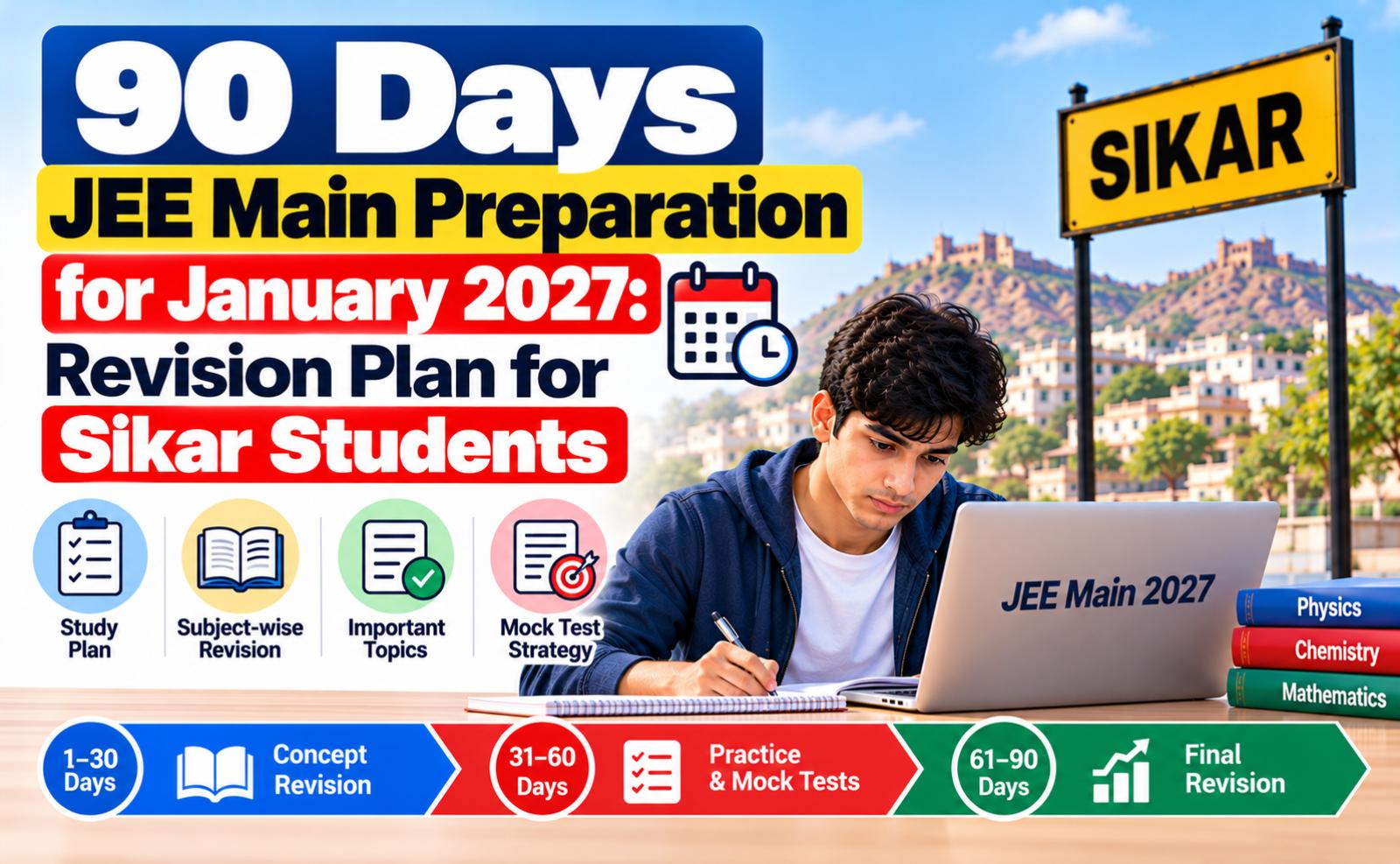
The 90-day timeline: 45 + 30 + 15 split
Anchor Day 1 about 90 days before your actual Session 1 date. If you start late, shrink phases proportionally (for example, 80 days ≈ 40 + 27 + 13).
| Phase | Duration | Focus | Mocks |
|---|---|---|---|
| Phase 1 | Days 1–45 | Priority chapters + chapter-wise PYQs | One full mock every Sunday |
| Phase 2 | Days 46–75 | Remaining studied chapters, weak areas, mixed drills | Two full mocks per week |
| Phase 3 | Days 76–90 | Full mocks, formula sheets, error notebook only | Alternate days; no mock the day before exam |
In Phase 1, run Physics, Chemistry, and Mathematics priority lists in parallel. Rough guide: about three study days per Physics priority chapter (group KTG+Thermo and Modern blocks), about four days per Chemistry and Maths priority chapter, with spare days parked on Optics, Rotational Motion, Coordinate Geometry, and Integral Calculus.
Phase 3 is sacred: no new chapters. Analyse each mock the same evening; use the gap day to fix concept gaps flagged in the paper. Keep three- to four-page crisp notes per chapter so final revision is a scan, not a reread of textbooks.
Daily timetable for Sikar: school vs dropper
Coaching cities work when sleep is protected. Aim for at least seven hours of sleep; all-nighters destroy mock accuracy faster than they “cover syllabus.”
| Time | Class 12 (with school) | Dropper |
|---|---|---|
| Morning | Chemistry NCERT + formulas | Mathematics (fresh mind) |
| Day | School / coaching classes | Physics revision + PYQs |
| Afternoon | Mathematics timed set | Chemistry NCERT block |
| Evening | Physics revision | Mixed practice or mock analysis |
| Night | PYQs + error notebook | Formula sheets + error notebook |
On mock days, replace your two longest study blocks with a three-hour CBT-style sitting; analyse the same night. Parents comparing institutes should read best JEE coaching in Sikar for Main and Advanced and PCP Sikar vs Matrix for JEE for fit, not just brand names.
Mock tests and PYQs: what actually moves percentile
PYQs teach how NTA frames concepts; mocks teach whether you can execute under time and screen fatigue. In Phase 1, solve the last three years’ questions chapter-wise after each unit. In Phases 2–3, full papers dominate.
After every mock, same-day protocol:
Mark wrong and skipped items.
Tag each as concept gap, calculation slip, or time pressure.
Fix concept gaps within 48 hours.
One-line entry in your error notebook.
Reattempt those questions after seven days.
Take mocks on a desktop or laptop, phone in another room, mix morning and afternoon starts so Session 1 shift timing does not surprise you. Target roughly 20–22 full mocks across 90 days if analysis keeps pace—never stack new mocks on unreviewed old ones.
Board exams alongside JEE Main
Class 12 students in Sikar often carry CBSE or state board pressure with January JEE. Do not treat boards and JEE as two separate silos for Class 12 chapters. For each shared unit, read NCERT once, write two short board-style answers, then same-day JEE Main PYQs.
Start Phase 1 with Class 12 priority overlap—Electrostatics, Chemical Kinetics, Integral Calculus, etc.—and mark pre-board dates on your wall calendar before you assign chapter days. Droppers can skip board-specific blocks and redirect that time to mixed mocks.
Mistakes Sikar aspirants should avoid in the last 90 days
Starting heavy new chapters after Day 75—steals mock and revision days.
Buying new books or rewriting notes—feels productive but eats PYQ time; stay on NCERT, coaching sheets, and one formula page per chapter.
Ignoring two subjects for a week—each carries 100 marks; daily touch all three even if one slot is only 30 minutes.
Advanced-level problem obsession—finish Main PYQs first; add toughness only where you are already stable.
Treating January as fake—April helps, but January gives real data; attempt selection and accuracy habits form now.
Last week and exam day checklist
In the final seven days, revise only what you know: formula sheets, short notes, error notebook. Align sleep with your shift—morning candidates need early sleep; afternoon candidates should avoid long naps that break night rhythm.
Day before: trace the route to your centre (many Sikar students travel to Jaipur or other cities—reach early if needed). Carry printed admit card with self-declaration, ID proof, and passport photos as per the bulletin; centres provide pen and rough sheets.
Exam day: reach well before gate-closing time; ignore panic chatter outside; if Q1–Q5 feel hard, skip and return—difficulty is shift-wide, not personal.
Conclusion
Ninety days before JEE Main January is not the time to pretend the syllabus was finished perfectly. It is the time to put every chapter into a clear box—revise first, basics plus PYQs, revise next, or leave for now—and let weekly mocks prove whether your choices work. Sikar has no shortage of coaching options, from established JEE campuses to newer hybrid centres; what converts that environment into a rank is ordered revision, honest mock analysis, and sleep you actually keep.
Start tomorrow: build your four-box sheet, open your highest-yield studied chapter, and register for the session if you have not already. Your January score is built from the order you follow this week—not from the chapter you fear most but never finish.